
Introduction: The Hidden Cost of “Just Picking”
At 8:00 AM, your picker starts on the first order of the day—an order containing 12 distinct SKUs.
To fulfill it, he treks to Rack A3 for screws, maneuvers to B7 for washers, and then crosses over to Area D to grab a tool set. By the time that single order is wrapped up, he has already logged nearly 1,000 feet (about 300 meters) inside the facility.
By the end of his shift, his total walking distance can easily reach 7 to 9 miles (11 to 14 kilometers).
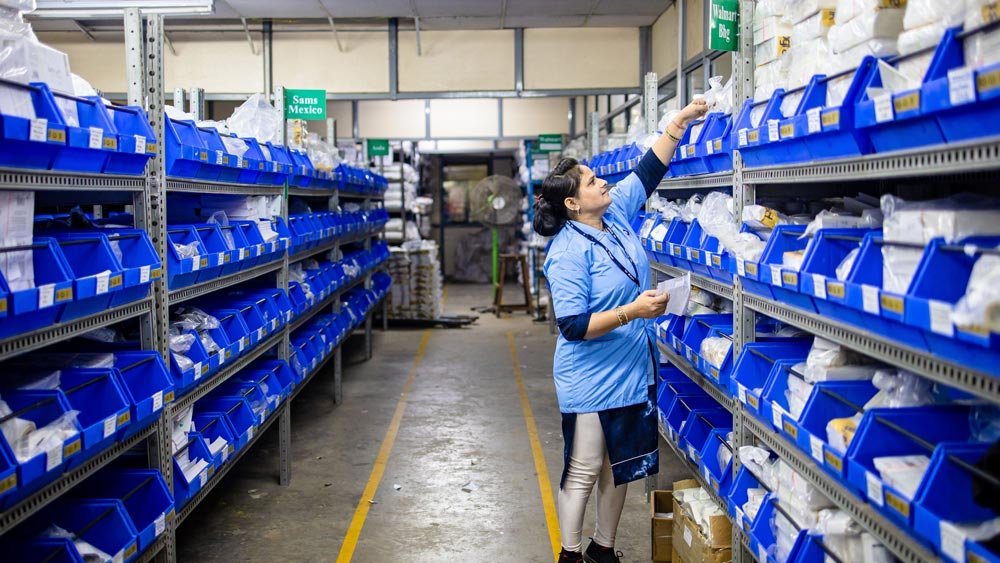
Sound exaggerated? Industry research reveals that warehouse pickers walk an average of 6 to 9 miles every single day. That means over 50% of their billable labor hours are spent simply walking rather than actually picking goods.
To make matters worse, picking efficiency for multi-SKU orders is often more than 40% lower than single-SKU picks. The more complex the order, the higher the error rate. Customer complaints, re-picks, and returns—these are all hidden expenses baked into a standard “just picking” operation.
So what is the solution?
The answer isn’t “hire more people.” It’s shifting how you handle fulfillment: adopting kitting.
Yet here is the critical insight most articles overlook:
Kitting isn’t merely a workflow tweak—it reshapes the physical layout of your facility. How your racks are configured, where components reside, and where kitting stations are positioned directly dictate operational efficiency far more immediately than software or procedures ever could.
In this guide, we break down warehouse kitting from a warehouse manager’s perspective, focusing on how racking setups and layout strategies can align with kitting to maximize output.
What Is Kitting in Warehouse? — A Quick Definition
Let’s establish a clear baseline.
Warehouse kitting is the process of pre-assembling multiple complementary SKUs into a single unified “kit,” assigning it a new, unique SKU, and storing, picking, and shipping it as a single unit.
A few everyday examples illustrate this best:
- Hardware kits: Combining a screwdriver, screws, wall anchors, and an instruction sheet into a single “installation kit.”
- Medical procedure packs (surgical trays): Pre-packaging all necessary instruments and disposables into a single sterile kit.
- Electronics accessory bundles: Combining a phone, charger, earbuds, and protective case into a “starter kit.”
- Automotive repair kits: Pre-packing all OEM components required for a specific maintenance routine.
Notice the core action here: Pre-assembling + Assigning a new SKU.
Once a kit is assembled, your Warehouse Management System (WMS) treats it as one standalone product. When an order lands, a picker only travels to one location to pick one unit, rather than trekking across the entire warehouse.
That is the fundamental logic behind kitting.
Kitting vs. Bundling: Clearing the Confusion
At this point, you might wonder: How does this differ from “bundling”?
While these terms are frequently used interchangeably, their physical reality on the warehouse floor is distinct.
Here is a side-by-side comparison:
| Dimension | Kitting | Bundling |
| Assembly Timing | Pre-assembled prior to order placement | Grouped at or after order placement |
| Physical State | Components physically combined into one item | Items may remain separately packaged; sold together |
| SKU Management | Assigned a new, unique SKU | Retains individual SKUs |
| Storage Method | Stored as a single SKU/unit | Stored separately; picked to fulfill the bundle |
| Primary Goal | Streamline picking efficiency | Boost average order value (AOV) or promotional sales |
Put simply:
- Kitting is a warehouse operation focused on physically unifying items so they can be picked in a single move.
- Bundling is a sales strategy focused on pricing multiple items together.
Since you are making warehouse layout decisions, our focus here is strictly on kitting.
The 5 Types of Warehouse Kitting (And How Each Affects Your Racking)
Let’s dive deeper.
In logistics, kitting generally falls into 5 main categories. Each places unique demands on your racking system. Understanding these distinctions is step one in designing an efficient facility layout.
Order Kitting
Assembling kits on-demand based on incoming customer orders.
For instance, when an e-commerce order contains 5 distinct SKUs, warehouse staff group them into a single package during fulfillment. Assembly begins only after the order is placed.
Racking Impact:
- Requires a dynamic picking zone that adapts to fluctuating order profiles.
- Component racks should sit close to kitting stations so pickers don’t assemble items deep in the aisles.
- Circular or fan-shaped racking arrangements around kitting stations work best.
Assembly Kitting
Pre-packaging sub-assemblies for production lines or downstream manufacturing processes.
For example, in a furniture factory where each desk requires 20 screws, 4 legs, and 1 tabletop, these parts are pre-kitted and dispatched directly to the assembly line.
Racking Impact:
- Racks must be organized around takt time (production pace), with high-demand components placed nearest to assembly areas.
- Minimizes vertical and horizontal travel between component racks and assembly lines.
- Typically relies on sequential picking layouts, matching rack numbering to the exact order of assembly.
Promotional Kitting
Creating kits for marketing campaigns, seasonal events, or promotional giveaways (e.g., holiday gift sets, sample packs, or branded bundles).
Racking Impact:
- Highly seasonal with sharp peak-season spikes, requiring easily reconfigurable rack setups.
- Adjustable shelving or modular racking systems are ideal.
- Often requires temporary buffer storage that can expand during promotional pushes without structural overhauls.
Replenishment Kitting
Pre-combining items into replenishment units destined for specific retail stores or locations (e.g., convenience store chains receiving custom item assortments in a single pack).
Racking Impact:
- Kits should sit near the loading docks or outbound staging areas.
- Shelf heights and picking methods must match outbound dispatch frequencies.
- Gravity-fed systems like carton flow or pallet flow racks help maintain strict FIFO (First-In, First-Out) rotation.
Subscription Box Kitting
Assembling recurring items for subscription-based services (e.g., monthly subscription boxes containing fixed product sets). This has been one of the fastest-growing kitting models in recent years.
Racking Impact:
- High-frequency and repetitive, requiring heavily optimized picking paths.
- Component racks should be densely clustered around dedicated kitting stations.
- Frequently pairs with automated equipment (like conveyors or AMRs), requiring racking with integrated automation touchpoints.
Here is a summary of the 5 types and their racking requirements:
| Kitting Type | Assembly Timing | Core Racking Requirement | Recommended Racking Type |
| Order Kitting | Order-triggered | Dynamic and flexible | Shelving + Carton Flow Rack |
| Assembly Kitting | Pre-production | Sequential, aligned with takt time | Dedicated kitting racks + Sequential location coding |
| Promotional Kitting | Campaign-driven | Reconfigurable and scalable | Modular Shelving |
| Replenishment Kitting | Scheduled cycles | FIFO-compliant, dock-adjacent | Carton Flow / Pallet Flow Rack |
| Subscription Box Kitting | Periodic cycles | Optimized pick paths, high-frequency picking | AS/RS + Dedicated Kitting Stations |
The Warehouse Kitting Process — Step by Step (With Racking Considerations)
Now that we’ve covered the types, let’s walk through the full kitting process step by step, evaluating each stage from a racking perspective.
Step 1: Identify Kit Components
Start with data analysis.
Examine historical order records to identify items frequently purchased together. These combinations make prime candidates for kitting.
A practical approach is using ABC-XYZ analysis:
- A-Class (high frequency) + X-Class (stable demand) = Top priority for kitting.
- C-Class (low frequency) + Z-Class (volatile demand) = Approach with caution.
Racking Impact:
- Move high-frequency components (picked multiple times a week) into your warehouse’s “golden zone” (waist-to-chest height, near outbound lanes).
- Store low-frequency items on higher shelf levels or in deeper warehouse zones.
Step 2: Design the Kit and Assign SKU
Define the physical characteristics of the finished kit: What packaging will be used? What are its dimensions and weight?
Next, register a unique SKU for the assembled kit in your WMS.
Racking Impact:
- As a new SKU, the kit requires dedicated storage locations configured in your WMS.
- Physical dimensions determine the ideal storage format (e.g., pallet racking, tote bins, or shelving).
- Plan kit storage spaces ahead of time to avoid cluttered overflow.
Step 3: Optimize Warehouse Layout for Kitting
This is the most crucial step—and where most kitting overhauls run into friction.
Two vital decisions to make:
Where should the Kitting Station be located?
- Near the shipping dock to minimize transport distances for finished kits.
- Near high-frequency component zones to reduce travel time for pickers.
- Off main aisles to prevent congestion with routine picking traffic.
How should components be laid out?
- Position high-turnover components in the golden zone.
- Keep components for the same kit clustered together or on adjacent racks.
- Avoid splitting components across opposite ends of the building.
Two proven layout models:
U-Shaped Layout:
[ Receiving Dock ] →→→→ [ Component Storage ] ↓
[ Kitting Station ]
[ Shipping Dock ] ←←←← [ Kit Storage ] ↑
- Ideal for high-mix, low-volume setups.
- Unidirectional material flow keeps pathways clean and logical.
- Well-suited for most e-commerce and distribution centers.
I-Shaped (Inline) Layout:
[ Receiving Dock ] → [ Component Storage ] → [ Kitting Station ] → [ Kit Storage ] → [ Shipping Dock ]
- Designed for high-volume, continuous-flow operations.
- Assembly-line efficiency yields extremely high throughput.
- Excellent for manufacturing prep and subscription box fulfillment.
Racking Impact:
- Once layout design is finalized, rack specs and placement naturally follow.
- Run simulations (or simple walk-through tests) before purchasing or bolting down racks.
- Calculate aisle width and turning radii beforehand to accommodate material handling equipment.
Step 4: Pick Components and Assemble Kits
Pickers retrieve items from component racks based on system prompts and deliver them to the kitting station for assembly.
Racking Impact:
- Travel distance between component racks and kitting stations directly drives picking throughput.
- Every component rack must feature clear labeling (SKU + location code).
- Picking paths should follow a logic that eliminates backtracking.
Step 5: Store Completed Kits
Assembled kits are placed in designated kit storage zones as complete units.
Racking Impact:
- Kit storage should sit near outbound shipping, taking priority over individual component storage.
- Kit weight and size dictate racking type (heavy kits require pallet racking; lighter kits fit shelf units).
- Fast-moving kits belong in the golden zone for effortless retrieval.
Step 6: Fulfill Orders
When an order arrives, the kit is picked, packed, and shipped as a single SKU.
Racking Impact:
- Kits should occupy easily accessible rack levels (lower tiers, aisle-facing, near loading docks).
- Because this relies on “picker-to-parts” methods, rack ergonomics (reach depth and height) directly influence worker speed and comfort.
The Benefits of Kitting (And How the Right Racking Multiplies Them)
Now let’s examine the payback. What value does kitting unlock for your facility, and how does the right racking amplify those gains?
Faster Order Fulfillment
Pre-assembling kits means pickers grab one item and go, instead of hunting through aisles.
Real-World Impact: Studies show fulfillment times routinely drop by 40–60%.
Racking Advantage:
- Positioning kit storage right next to shipping cuts another 20–30% off picking times.
- Flow racks maintain continuous FIFO inventory circulation.
Reduced Picking Errors
Picking one single kit is far less error-prone than picking 5 or 10 separate components.
Real-World Impact: Industry data shows kitting can cut picking errors by over 70%.
Racking Advantage:
- Clear rack labels and pick-to-light indicators drop error rates by an additional 30–50%.
- Zoned racking layouts keep pickers focused and minimize distractions.
Higher Average Order Value (AOV)
Bundling items into kits encourages buyers to purchase more at once.
Real-World Impact: In B2C environments, kit offerings lift average order value by 15–25% over standalone item sales.
Racking Advantage:
- Visual organization at staging areas streamlines promotional assembly and dispatch.
- High-visibility rack end-caps and floor displays work well for fast kit access.
Move Slow-Moving Inventory
Underperforming items can “ride shotgun” inside popular kits. Grouping slow-moving accessories with bestsellers accelerates turnover.
Real-World Impact: Can boost slow-moving inventory turnover by 2x to 3x.
Racking Advantage:
- Reconfigurable adjustable shelving makes it simple to swap component configurations on the fly.
- Introducing seasonal or temporary kits requires zero rack structural overhauls.
Optimized Warehouse Space Utilization
Consolidating loose items into pre-packed kits eliminates fragmented storage and recovers usable floor space.
Real-World Impact: Increases storage density per square foot by 25–40%.
Racking Advantage:
- High-density solutions (like AS/RS or shuttle racking) maximize vertical space capture.
- Concentrated kit storage yields much better space efficiency than scattered component binning.
Summary of benefits and racking advantages:
| Benefit | Impact from Kitting Alone | Boost with Racking Optimization | Key Racking Feature |
| Fulfillment Speed | 40–60% faster | Additional 20–30% boost | Golden zone placement, Flow racks |
| Picking Accuracy | 70% error reduction | Additional 30–50% error drop | High-contrast labels, Pick-to-light |
| Average Order Value | 15–25% increase | Sustained throughput support | End-caps, Visual layout |
| Slow Inventory Turn | 2x–3x turnover speed | Flexible, adaptable support | Adjustable shelf heights |
| Space Utilization | 25–40% density increase | Maximum vertical space capture | High-density shuttle / AS/RS |
Best Practices for Kitting-Friendly Warehouse Racking
This section dives into insights rarely found in standard logistics guides. While many articles cover software or workflow, half of kitting success relies on physical racking infrastructure.
Here are 5 battle-tested rules from real-world projects:
1. Zone Your Warehouse for Kitting Efficiency
Establish 5 distinct, well-defined functional zones:
[ Receiving Dock ] → [ Component Storage ] → [ Kitting Station ] → [ Kit Storage ] → [ Shipping Dock ]
Recommended racking for each zone:
| Zone | Main Function | Recommended Racking | Primary Consideration |
| Receiving | Inbound staging | Floor staging + Pallet Racking | Close to receiving dock for fast inspection |
| Component Storage | Raw SKU storage | Shelving + Pallet Racking | Zoned strictly by pick frequency |
| Kitting Station | Kit assembly | Workbench + Light Shelving | Keep components within arm’s reach |
| Kit Storage | Finished kit storage | Shelving + Carton Flow Rack | Position near shipping; strict FIFO |
| Shipping | Outbound packing | Conveyors + Staging Shelving | Direct line to loading docks |
2. Choose the Right Racking for Component Storage
Different components demand different racking styles. Select hardware based on item scale and picking volume:
- Small, High-Frequency Items → Industrial Shelving or Bin Systems
- High visibility, quick retrieval.
- Bin units keep small hardware dust-free and organized.
- Large, Low-Frequency Items → Heavy-Duty Pallet Racking
- High weight capacity, superior vertical space utilization.
- Serviced easily via forklifts.
- Fast-Moving, High-Volume Items → Carton Flow Racks (Gravity Feed)
- Enforces FIFO stock rotation and drastically reduces picking time.
- Condenses aisle needs to boost storage density.
- Over-Sized or Extra-Heavy Items → Drive-In Racking or AS/RS
- Maximizes floor-to-ceiling footprint.
- Ideal for low-SKU, high-density applications.
3. Design an Ergonomic Kitting Station
A kitting station isn’t just a worktable—it’s a high-efficiency micro-environment where racking configuration dictates operator output.
Design Essentials:
- Components within arm’s reach: Eliminate repetitive bending, reaching, or turning.
- Dedicated bin placement: Every SKU has a fixed, clearly labeled spot so operators never search for parts.
- Tools on hand: Mount barcode scanners, label printers, and tape dispensers directly onto the station frame.
- Task lighting: Bright lighting prevents picking errors, especially with tiny hardware.
- Adjustable height: Ensure work surfaces adjust to match different operator heights comfortably.
4. Implement Pick-to-Light or Zone Picking
Racks shouldn’t just hold inventory—they should integrate into your warehouse tech stack.
Pick-to-Light Integration:
- Indicator lights mount directly on each component rack location.
- The system lights up the exact location needed for a kit.
- Pickers follow the lights, pushing accuracy close to 100%.
- Racking requirement: Internal wiring channels, regular rack spacing, and unobstructed light paths.
Zone Picking Strategy:
- The warehouse is split into dedicated picking sectors.
- Each operator manages a specific zone.
- Conveyors or mobile picking carts transfer work between zones.
- Racking requirement: Distinct floor markings, bold rack signage, and smooth roller conveyor integrations.
5. Plan for Seasonality and Flexibility
Kitting demands rarely stay static. Order surges during peak season can easily double volume, only to cool off afterward.
Your racking system must be built to adapt:
- Adjustable Shelves: Modify shelf heights quickly as kit dimensions change.
- Modular Frameworks: Add or remove rack bays without major structural overhauls.
- Mobile Racking Systems: Reconfigure aisle configurations on demand during peak periods.
- Expansion Capacity: Factor future growth into your initial floorplan.
Avoid rigid, fixed racking. Even if a system meets today’s needs, shifting inventory profiles will demand adjustments within months. Adaptability is rule number one in racking selection.
Case Study: How Racking Optimization Transformed a Kitting Operation
Consider this real-world operational overhaul (anonymized case study based on field data).
A mid-sized Direct-to-Consumer (DTC) fulfillment center managing ~12,000 SKUs and 2,500 daily orders implemented kitting. However, they hit immediate roadblocks: scattered components, poorly positioned stations, and high error rates.
Before Optimization:
- Components were scattered randomly across distant warehouse aisles.
- The kitting station was positioned in the middle of the warehouse floor.
- Pickers walked an average of 7.5 miles (12 km) per day.
- Average picking time per order: 18 minutes.
- Picking error rate: 3.8%.
After Optimization (Racking realignment + Relocating Kitting Stations):
- Grouped kit components together, placing top-5 high-frequency kit items in the golden zone.
- Relocated kitting stations adjacent to shipping docks and high-turnover storage.
- Installed carton flow racks in the kit storage zone next to loading docks.
- Integrated a pick-to-light system on component shelving.
Results After 6 Months:
| Metric | Before | After | Improvement |
| Daily Picker Walk Distance | 7.5 miles | 3.6 miles | ↓ 52% |
| Average Pick Time per Order | 18 mins | 7 mins | ↓ 61% |
| Picking Error Rate | 3.8% | 0.5% | ↓ 87% |
| Space Utilization | 62% | 88% | ↑ 42% |
| Daily Order Throughput | 2,500 orders | 4,800 orders | ↑ 92% |
The lesson is clear: Kitting provides the framework, but optimized racking is the engine that drives results.
Frequently Asked Questions About Warehouse Kitting
Q1: What is the difference between kitting and assembly?
Kitting involves pre-sorting and packaging multiple existing SKUs into a single new SKU for unified storage and picking. Assembly is a manufacturing step where raw components are physically put together to form a finished product. Kitting can feed an assembly line, but they are distinct processes.
Q2: What types of products are best for kitting?
- Highly complementary items frequently bought together.
- Product bundles with attractive profit margins (e.g., starter kits priced at a premium).
- Slow-moving stock paired with popular items to clear inventory.
- Not recommended for: Highly customized bespoke items or products requiring customer verification before assembly.
Q3: How do I know if kitting is right for my warehouse?
Look for these 3 indicators:
- Your average order contains 3 or more SKUs.
- Your picking error rate exceeds 2%.
- Your pickers walk over 5 miles (8 km) per shift.
If two or more apply to your operation, kitting is worth pursuing.
Q4: What racking system is best for kitting operations?
There is no single “best” system—only the right fit for your specific profile. However, these guidelines hold true:
- Component Storage: Industrial shelving for high-turnover items + pallet racking for bulk/low-turnover items.
- Kitting Station Area: Lightweight, adjustable modular shelving.
- Kit Storage: Carton flow racks for fast movers + standard shelving for slower turns.
- Overall Facility: Modular, adaptable racking systems.
Selection depends on your SKU profiles, order velocity, and physical space constraints.
Conclusion: Kitting Starts with the Right Foundation
You now have a complete, practical roadmap to warehouse kitting.
To recap the core takeaways:
- Kitting unifies multiple SKUs into one, dramatically streamlining picking operations.
- The 5 kitting models each require distinct racking strategies.
- Of the 6 process steps, Step 3 (Warehouse Layout Optimization) has the highest impact on success.
- Racking isn’t passive storage—it acts as a force multiplier for kitting efficiency.
- Flexibility and adaptability should be your top criteria when choosing racking hardware.
Remember:
Successful kitting relies 10% on software, 30% on process design, and 60% on physical infrastructure—your racking and floorplan.
If you’re planning a kitting overhaul or upgrading racking to support kitting workflows, start by evaluating two questions:
- Which kitting model best fits our current order profile?
- Does our current racking layout support modular, flexible kitting operations?
Once you have those answers, execution becomes straightforward.