
Hello! As a storage rack manufacturer, we constantly ask ourselves: how can we transform your warehouse from just a storage space into a high-performance logistics hub? The answer lies in a unified, dynamic digital map.
In traditional warehouse management, induction, picking, and packing often operate in silos, much like isolated islands. This disconnection leads to a host of issues, such as misplaced inventory, chaotic picking routes, and bottlenecks at packing stations. Today, let’s explore how a single intelligent map can link these core processes to achieve true visibility, control, and optimization.
In short, the core value of an integrated map is its ability to combine physical rack layouts, real-time inventory status, order flow, and personnel movement into one dynamic visual interface. This isn’t just about digitalization; it’s the foundation for global warehouse optimization and data-driven decision-making.
Designing Rack Layouts and Map Modeling for Peak Efficiency
Every leap in intelligence starts with a precise map. This map is far more than a simple floor plan; it is a digital twin of your entire operation.
From Static Racks to Dynamic Data Nodes
In a smart warehouse, every rack and storage slot you manufacture is no longer just a static steel structure. Instead, they are defined as intelligent data nodes within the map. Each node carries precise coordinates, dimensions, weight capacity, and—most importantly—the specific SKUs and real-time stock levels associated with it. This essentially gives every slot a unique ID card and a live status report.
Mapping Critical Process Coordinates
To keep processes moving, all traffic hubs must be clearly marked on the map. These include:
- Induction Points: Where goods enter the system and receive smart assignments.
- Picking Start Points/Workstations: Where picking tasks begin.
- Packing Stations: Where orders go after picking is complete.
- Staging Areas: The final assembly point before loading.
Accurately marking these coordinates provides the physical foundation for all intelligent pathfinding, whether for human workers or Autonomous Mobile Robots (AMRs).
Establishing Encoding Rules for Your Racking System
A logical encoding system for racks and slots is the grammar that allows the map to communicate seamlessly with the Warehouse Management System (WMS). We recommend a hierarchical coding structure, such as: Zone – Aisle – Bay – Level/Slot. This works like a unique zip code for every location, allowing the system to instantly resolve its position for precise locating and efficient stock counting.
Intelligent Induction and Slotting Optimization Based on the Map
Putting items in the right place is half the battle for efficient picking. An intelligent map turns induction from a simple gap-filling exercise into a strategic layout.
Dynamic Induction Task Allocation
Traditional induction is about finding the nearest empty spot. A smart map system, however, acts like a strategist by considering:
- Real-time slot availability.
- SKU velocity (based on ABC analysis).
- Future order forecasts.
The system then calculates and assigns a long-term optimal location for incoming goods. For example, high-frequency Class A items are placed in prime real estate closer to the packing area.
Providing Navigation for Inbound Personnel
Calculated optimal locations need to be intuitively guided to operators via map navigation. Through handheld terminals or wearables, operators see clear directional arrows and destination markers, ensuring goods are placed accurately and quickly, thus eliminating human error.
Driving Optimal Picking Paths and Strategy Execution
This is where the smart map truly shines, turning picking from a physical grind into a high-speed game of strategy.
Dynamic Path Planning Beyond Simple Sorting
Path planning in a smart map goes far beyond just sorting order lines. It merges real-time data including:
- The dynamic order pool.
- The live location of multiple pickers or devices.
- Instant traffic congestion in aisles.
This allows the system to generate truly shortest, smoothest personalized paths for every picker, significantly reducing walking distance and backtracking.
Visual Execution of Strategies on the Map
Whether you use wave picking, zone picking, or discrete picking, these strategies can be visualized directly on the map. Managers can see task blocks formed by different waves and heat maps of order flow within zones, making it easy to monitor progress and reallocate resources at a glance.
Coordination with Automated Equipment
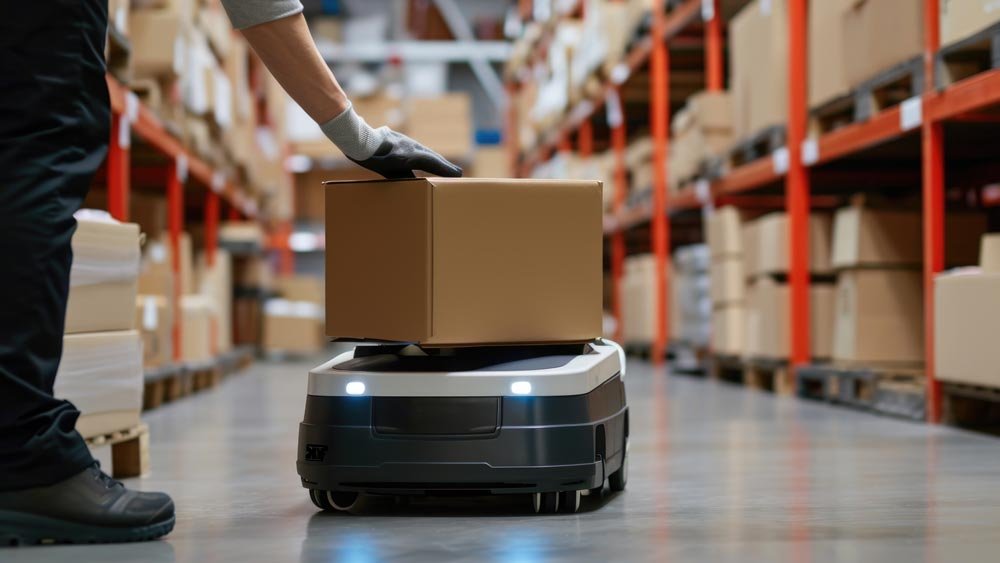
In automated warehouses, the map serves as the traffic control center. It schedules AMRs to specific racks, plans conveyor flow paths, and seamlessly connects goods-to-person or order-to-person stations for efficient human-machine collaboration.
Seamless Transition to Packing and Shipping for a Closed Loop
A smart process doesn’t end when picking is done; it ends when the goods are successfully shipped. The map ensures a smooth handoff from picking to dispatch.
Predictive Packing Station Scheduling
When the map system detects that a picking wave is nearing completion, it can predict the upcoming workload for each packing station. It then intelligently routes orders to less busy stations or prepares packing materials in advance, preventing the packing stage from becoming a bottleneck.
Visual Management of Shipping Areas
The shipping staging area also requires fine-tuned management. The map can clearly display which carrier, shipment batch, and loading sequence corresponds to each pallet position. Loading crews can work in the optimal order, drastically reducing vehicle wait times at the dock.
Data Loops and Continuous Optimization
The real power of an intelligent map lies in its ability to learn and evolve. It continuously gathers data on time, distance, and efficiency throughout the entire process. This feedback is used to:
- Refine ABC classifications and slotting plans.
- Adjust pathfinding algorithm parameters.
- Improve wave combination strategies.
This creates a cycle of continuous improvement for warehouse efficiency.
Implementation Framework: Deploying an Integrated Map System
You might be wondering: how do we get started? Here are our recommendations.
Recommended Tech Stack
Deploying an integrated map system typically requires:
- Perception Layer: IoT sensors (like slot occupancy sensors) and high-precision positioning (UWB, Bluetooth AoA, etc.).
- Software Layer: A core map engine platform with robust APIs for seamless integration with your WMS and OMS.
- Interaction Layer: Handheld terminals, vehicle-mounted tablets, or wearable devices for staff.
Integration Points with Physical Racking
As a rack manufacturer, we understand the importance of hardware-software synergy. During the design phase, we can pre-plan for:
- Installation points and cable routing for sensors (like light strips or weight sensors).
- Brackets for QR codes or ESL (Electronic Shelf Labels).
- Structural optimizations tailored for AMR access.
This ensures your racks are digital-ready from day one for a more perfect integration.
Phased Roadmap
We recommend a start small, move fast implementation strategy:
- Pilot Phase: Choose a representative area (like a high-velocity zone) for map modeling and guided induction trials.
- Expansion Phase: Roll out intelligent picking path planning to more zones.
- Integration Phase: Connect the packing and shipping areas to complete the loop.
- Optimization Phase: Use full-process data to continuously refine algorithms and strategies.
Conclusion
In summary, a unified smart warehouse map acts like real-time GPS and air traffic control for your facility. It links once-isolated processes—induction, picking, and packing—into an efficient, adaptive, and predictable flow. While physical racks hold the goods, the digital map provides the intelligence and direction for that flow.
This is more than a technical upgrade; it’s an operational revolution. Ultimately, it delivers lower operating costs, higher throughput, better space utilization, and a significant return on investment. As your partner, we are dedicated to providing racking solutions that are both structurally sound and intelligently connected, building the smart warehouses of the future together.