
In today’s fast-moving market, rapid and accurate delivery has become the bedrock of business survival. If you manage a warehouse, you know firsthand that traditional operating models are hitting their absolute limits.
Introduction
The Digital Transformation of Modern Warehousing
Step inside a modern logistics center, and you will witness a quiet revolution. The once-noisy manual operations are steadily being replaced by quiet, highly efficient automated systems.
At the heart of this transformation is Artificial Intelligence (AI)—the ultimate “brain” of the operation. AI is doing more than just rewriting how software functions; it is profoundly reshaping how every physical device in the warehouse collaborates.
Why Standard Storage is No Longer Enough
In the past, warehouse racks were treated as mere static structures of steel and iron. We used to categorize zones using rigid rules, such as placing heavy items on lower levels and lighter items on top.
However, with massive SKU volumes and highly unpredictable order flows, this static storage method falls short. Relying solely on conventional physical storage leaves warehouses vulnerable to redundant picking paths and poor space utilization. Modern warehousing requires a perfect fusion of physical footprint and digital intelligence.
What is a Common Application of AI in Warehouses?
How does AI actually integrate into everyday warehouse operations? Here are three of the most common and mature AI application scenarios today:
1. AI-Driven Dynamic Slotting Optimization
Do you frequently run into situations where sudden spikes in demand for certain items force pickers to constantly sprint from one end of the warehouse to the other?
AI-driven dynamic slotting is designed to eliminate this exact bottleneck.
- Real-time analysis: AI evaluates seasonal trends, sales promotions, and historical order data on the fly.
- Smart allocation: It automatically identifies high-frequency items and slots them at optimal picking heights (commonly called the “golden zone”) and in aisles nearest to the loading docks.
- Reduced wear and tear: This fluid rearrangement can slash picker travel distance by 30% to 40% while notably reducing equipment wear.
2. Fleet Management for Autonomous Mobile Robots (AMR)
If we compare racking aisles to city streets, Autonomous Mobile Robots (AMRs) are the vehicles driving on them. When hundreds of robots operate simultaneously, how do you prevent traffic jams?
AI serves as an advanced traffic controller in this scenario:
- It calculates the absolute best path for each robot in real-time, handling dispatch commands down to the millisecond.
- If a specific aisle gets congested, the AI proactively reroutes other robots around the bottleneck.
- This macro-level path optimization ensures that traffic flow between racking rows remains fluid and uninterrupted.
3. Predictive Demand and Smart Inventory Management
The best management is proactive. AI uses machine learning algorithms to predict which product categories will trend upwards weeks or even months ahead.
Based on these forecasts, the system adjusts the physical layout of the racks before peak demand strikes. By clustering high-demand inventory in easily accessible locations, it smooths out the operational strain of high-volume periods.
The Missing Link: How AI Reinvents Physical Warehouse Racking
It is easy to assume that AI is purely a software technology. However, even the most brilliant digital “brain” cannot function effectively without high-quality, intelligently designed physical racking.
High-Density AS/RS and Smart Shuttle Systems
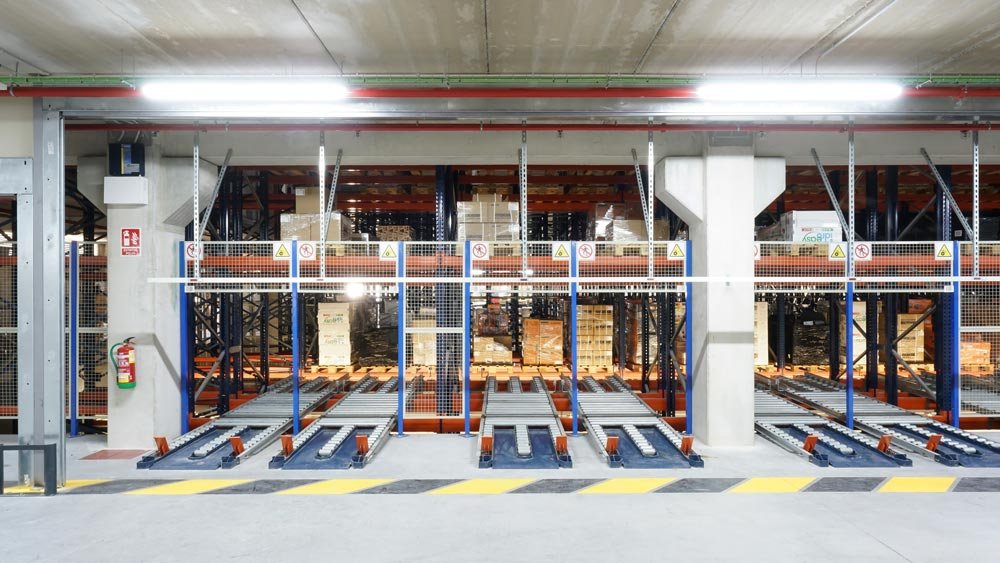
In high-density Automated Storage and Retrieval Systems (AS/RS), AI scheduling algorithms must operate in perfect harmony with precision-manufactured shuttle racking.
| Dimension | Conventional Shuttle Racking | AI-Driven Smart Shuttle Racking |
| Positioning Accuracy | Centimeter-level, relying on physical limit stops | Millimeter-level, combining AI models with precision sensors |
| Space Utilization | High, but limited by structural blind spots | Maximized, with AI-optimized multi-tier, multi-vehicle spatial pathing |
| Response Speed | Sequential queueing, prone to idle wait times | Parallel execution, fleet-wide coordination for near-instant arrival |
To achieve millimeter-level accuracy, structural tolerances during racking manufacturing—such as levelness, alignment, and material fatigue resistance—must meet exceptional standards.
Computer Vision: AI-Powered Racking Safety Inspections
Traditional annual audits and routine physical inspections are incredibly time-consuming, labor-intensive, and prone to human oversight.
Now, computer vision technology allows AI to make safety inspections simple and highly efficient:
- Automated scanning: By mounting cameras onto forklifts or drones, the system automatically scans the racking structure as they move.
- Instant detection: It spots tiny irregularities—like slightly warped uprights, beam deflection, or missing safety pins—in a matter of seconds.
- Accident prevention: This automated monitoring can slash the risk of structural failure and racking collapses by more than 90%, shielding your facility and workforce.
Weight Distribution and Structural Integrity Under AI Routing
When AI algorithms push efficiency to its absolute limit, they can sometimes cluster heavy inventory in a single zone, introducing localized physical overload risks.
Smart racking designs combat this by pairing IoT sensors with the Warehouse Management System (WMS):
- Sensors integrated into key structural nodes monitor load distribution in real-time.
- This structural data feeds back into the AI system. If a section approaches its safe load threshold, the AI dynamically reroutes incoming pallets to alternative storage zones.
- This active dialogue between digital logic and physical steel preserves your facility’s long-term structural integrity.
Preparing Your Infrastructure: How to Design Racks for AI-Ready Warehouses
If you plan to introduce AI-driven automation down the road, laying the right physical foundation begins at the initial racking design phase.
Tolerance and Precision: The Standards of Automated Racking
Smooth, continuous AI automation relies heavily on high-precision physical hardware. For automated racking setups (such as four-way shuttles or crane-based structures), tolerance and precision are the ultimate lifelines:
- Upright verticality deviation must be held within extremely tight millimeter-level limits.
- Track flatness directly dictates vehicle travel speeds, navigation accuracy, and the operational lifespan of your robots.
- It is highly recommended to design and manufacture structures in strict compliance with international automated warehousing standards, such as FEM or ISO.
Modular and Scalable Racking Designs for Future AI Upgrades
Warehouse needs shift constantly, meaning your racking infrastructure must be future-proof.
- Modular design: Opt for systems that allow you to adjust beam heights or expand tiers effortlessly without disrupting the existing framework.
- Scalable infrastructure: Pre-engineer connection points for future sensor add-ons or running tracks. Even if you start with basic selective racks today, you can upgrade to an AI-compatible automated setup in the future with minimal cost and downtime.
Conclusion
The Future is Hybrid: Merging AI Brains with Robust Steel Racking
The next generation of smart warehousing is not a single-track technology upgrade. It is a seamless union between an ultra-smart AI brain and robust, highly engineered steel racking.
AI provides the sharp insight and rapid response capabilities, while high-performance physical racking safely carries the load. As professional racking manufacturers, we construct more than just durable steel frames—we build the intelligent physical foundation that lets your digital AI ecosystem thrive.
Are you ready to make your warehouse smarter and safer?