
In the landscape of modern global industry, managing the storage and transport of elongated, bulky, and irregularly shaped materials—such as metal tubing, plastic piping, or long bar stock—remains a formidable obstacle.
For facility managers, the ability to balance storage density, operational safety, and material throughput within a confined footprint directly dictates a company’s profitability and market edge.
The piperack system, often considered the “backbone” of industrial infrastructure, has evolved from a simple physical support into a highly sophisticated storage asset.
With the widespread adoption of Just-in-Time (JIT) manufacturing and lean logistics, the expectations for piperack systems have shifted from mere “weight-bearing” to “operational efficiency.” A well-engineered piperack does more than just shield expensive raw materials from damage; it acts as a catalyst for eliminating handling bottlenecks through deep integration with automation.
This guide explores piperack systems through the lenses of engineering design, performance metrics, efficiency optimization, and strategic procurement.
What is a Piperack System? Defining the Backbone of Industrial Infrastructure
A piperack system, also referred to as a pipe gallery or pipe bridge, is an elevated structural framework specifically engineered to support piping, cable trays, and related process equipment. It serves a vital organizational role within a plant or warehouse by diverting cluttered ground-level routing and material stacks into vertical space, thereby relieving floor pressure and enhancing overall site safety.
Industrial Process Piperacks: The Complex Circulatory System of Energy and Petrochemicals
In the oil and gas, refining, chemical, and power sectors, industrial process piperacks act as the central nervous system connecting various production units. Their primary function is to carry process piping that transports fluids, including utility lines (such as cooling water, instrument air, and steam) as well as raw material and finished product lines entering or exiting the facility.
The complexity of these structures lies in their need to withstand extreme operating conditions. For instance, the thermal expansion of fluids at high temperatures generates significant horizontal forces, while fluid surges can create sudden impact loads. Consequently, process piperacks are treated as non-building structures that must adhere to rigorous seismic and wind load standards. Their design is a collaborative effort between piping and structural engineers to ensure the absolute safety of hundreds of lines under vibration and thermal stress.
Warehouse Storage Piperacks: Specialized Solutions for Long-Span Raw Materials
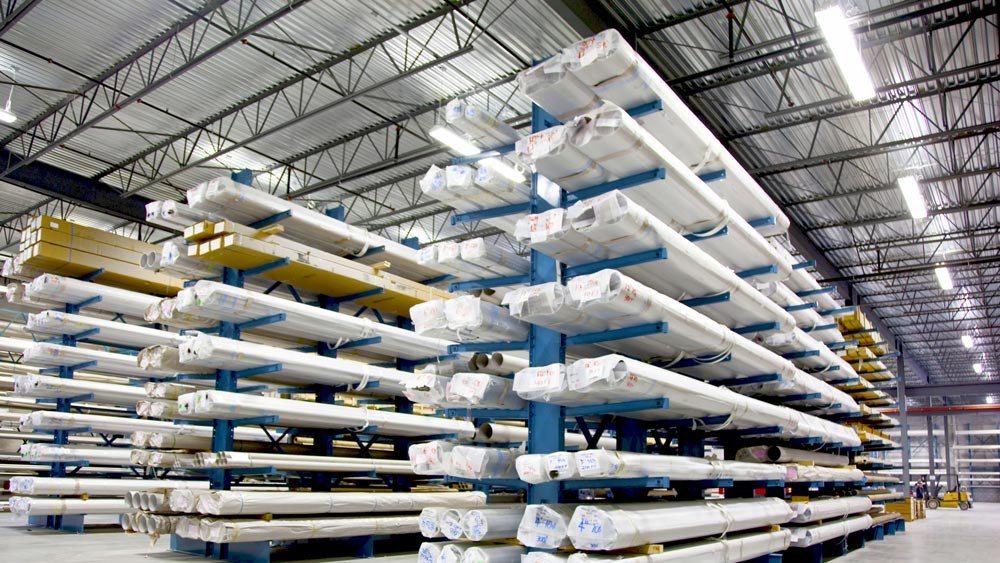
Unlike their process-driven counterparts, warehouse storage piperacks focus on static storage and dynamic retrieval. These systems are predominantly used for housing metal pipes, HSS (Hollow Structural Sections), PVC tubing, and other elongated raw materials.
Traditional floor stacking often leads to “compression loss,” where the bottom layers of material bend, deform, or suffer scratches under excessive weight. Professional warehouse piperacks provide a rigid “exoskeleton” that transfers loads directly through the steel frame to the ground, preventing materials from crushing one another. Often modular in design, these systems can be adjusted based on material length and weight, making them indispensable for modern metal fabrication and construction material distribution centers.
The Engineering Mechanics of Core Components and Structural Design
The stability of a piperack system is the result of a deep understanding of physical loads and material properties. Every component must meet specific mechanical criteria.
Columns and Beams: How Steel Grades Dictate Load Capacity
Columns serve as the primary vertical load-bearing members, while cross beams create the material support plane. Industry standards provide clear guidelines for selecting structural steel.
| Structural Component | Common Steel Grade | Minimum Yield Strength (fy) | Tensile Strength (fu) | Typical Application |
| Hot-rolled W-sections | ASTM A992 | 350 MPa | 450 MPa | Primary load-bearing columns and beams |
| Angles and Channels | ASTM A36 | 250 MPa | 400 MPa | Secondary supports and diagonal bracing |
| Plates and Flat Bars | ASTM A36 | 250 MPa | 400 MPa | Connection plates and stiffeners |
| Anchor Bolts | ASTM F568M Class 4.6 | 240 MPa | 400 MPa | Foundation anchoring |
Material selection directly affects the “strength-to-weight ratio.” Utilizing A992 steel allows columns to maintain a slimmer profile while supporting greater vertical pressure—a critical factor in warehouse environments where maximizing aisle width is essential. Beam design focuses on deflection control, typically requiring that deflection under full load does not exceed 1/240 of the span to prevent permanent warping of the stored materials.
Vertical and Horizontal Bracing: Ensuring Structural Integrity Under Heavy Loads
In a piperack system, a simple post-and-beam frame is insufficient to resist lateral forces from wind, seismic activity, or forklift impacts. Bracing must be integrated to form a stable geometric unit.
- Vertical Bracing: Usually implemented via K-bracing, X-bracing, or diagonal struts. These members transfer longitudinal forces from the beam levels to the foundation, preventing the structure from “parallelogramming” or racking. In seismic zones, the density and ductility of these connections are central to compliance.
- Horizontal Bracing: Located at the top or intermediate beam levels, this bracing ensures that horizontal loads (such as wind or pipe friction) are distributed evenly across all columns.
Ancillary Components: Safety and Maintenance Guarantees
A comprehensive piperack system also includes critical accessories to improve operational safety:
- Ladders and Platforms: For multi-tier industrial racks, access paths must comply with OSHA standards. Platforms are typically designed for a live load of 3.6 kN/m² and feature slip-resistant gratings.
- Impact Guardrails: Since warehouse piperacks frequently interact with forklifts, installing heavy-duty guards at the base of columns can effectively absorb impact energy, preventing structural failure due to fatigue or accidents.
- High-Strength Bolted Connections: Critical load-bearing joints generally use ASTM A325 high-strength bolts with full pre-tensioning to ensure frictional resistance under cyclic loading.
In-depth Comparison: Dedicated Piperack Systems vs. Standard Cantilever Racking
When storing long materials, many managers instinctively turn to cantilever racking. While cantilever racks offer certain access flexibility, dedicated piperack systems often provide a superiorReturn on Investment (ROI) through better space utilization and lower operational costs.
A Paradigm Shift in Space Utilization
Due to their structural nature, cantilever racks typically require very wide aisles—often exceeding 12 feet—to allow forklifts to access materials from the side. This results in a large portion of the warehouse floor becoming non-revenue-generating “aisle space.”
In contrast, modular or stackable piperack systems (such as unitized racks) allow for dense vertical stacking. Some systems use specialized “locating feet” to safely stack 4 to 5 layers high. Data suggests that within the same footprint, an optimized piperack system can achieve up to 400% the storage density of traditional methods.
Eliminating “Picking Bottlenecks”
On a cantilever rack, if the required material is at the bottom of a stack, operators must first move every bundle above it. This “honeycombing” effect can result in retrieval times of 20 to 30 minutes.
Dedicated piperacks promote a “unitized” storage logic. Materials are pre-loaded into the piperack frame, creating an independent, mobile unit. A forklift can transport an entire bundle (approximately 1.5 tons) in a single move from the storage area to the processing center. This workflow slashes retrieval times to under 3 minutes—a 90% boost in efficiency.
| Comparison Dimension | Cantilever Racking | Dedicated Storage Piperack |
| Storage Orientation | Horizontal, lateral access | Unitized, vertical stacking |
| Aisle Requirements | Extremely wide (12+ ft) | Narrower, supports compact layouts |
| Material Protection | Medium (prone to compression) | Extremely high (independent frame load) |
| Flexibility | Static and fixed | Dynamic, mobile, and reconfigurable |
| Volumetric ROI | Lower | Extremely high (up to 400% increase) |
Engineering Considerations and Compliance for High-Performance Piperack Systems
Designing a piperack system involves much more than simple welding; it requires rigorous engineering validation to ensure integrity under extreme conditions.
Load Capacity Calculations: Static, Operational, and Extreme Loads
Engineers use complex load combination models to determine capacity:
- Dead Load (D): Includes the weight of the steel frame, permanent equipment, and the empty weight of pipes.
- Operating Live Load (Do): The most critical metric, including the weight of fluids inside pipes and cable weights. The industry often uses 1.9-2.4 kN/m² as an estimate for pipe layers.
- Friction and Thermal Loads: Friction generated by the expansion and contraction of pipes cannot be ignored. Design forces are typically the greater of 10% of the total pipe weight or 40% of the heaviest single pipe.
- Wind and Seismic Loads: These must adhere to codes like ASCE 7. Seismic calculations often use the equivalent lateral force procedure based on Site Class and response modification coefficients (R = 3 to 3.5).
Adherence to RMI and OSHA Safety Standards
In North America and markets following similar protocols, rack design must comply with ANSI MH16.1. Published by the Rack Manufacturers Institute (RMI), this code underwent a significant update in 2021.
The latest standards define nine major design evaluation criteria, including the stiffness of beam-to-column connectors, base plate anchoring details, and site-specific seismic activity. Furthermore, OSHA mandates that all industrial racks display Load Capacity Plaques indicating the maximum safe weight for every level and unit; overloading is strictly prohibited.
Environmental Durability: Hot-Dip Galvanizing vs. Powder Coating
Surface treatment directly impacts maintenance costs and lifespan:
- Hot-Dip Galvanizing: Steel is submerged in molten zinc at 450°C, forming a zinc-iron alloy coating. This provides both a physical barrier and electrochemical “sacrificial” protection. It is ideal for outdoor, high-humidity, or corrosive industrial environments, with a lifespan reaching up to 50 years.
- Powder Coating: This involves electrostatic spraying followed by oven curing. It offers vibrant colors for zone identification and is environmentally friendly (zero VOC emissions). However, if the coating is scratched, the underlying steel can rust quickly, making it best suited for dry, indoor warehouses.
Five Ways an Optimized Piperack System Boosts Warehouse Efficiency
A well-planned piperack system is more than just a storage tool; it is a productivity accelerator.
1. Reducing Handling Damage and Material Loss
Traditional stacking often causes “banana-ing” (warping) in pipes, especially thin-walled versions. Dedicated piperacks act as an exoskeleton, transferring vertical pressure to the steel structure and ensuring materials remain perfectly straight. This asset protection directly reduces raw material scrap rates.
2. Enabling Automation Integration
Modern piperack systems serve as the foundation for Automated Storage and Retrieval Systems (ASRS). By combining shuttle systems and stacker cranes, companies can achieve 24/7 unmanned operations.
- Efficiency Gains: Automation can increase order processing speeds by 40% and reduce forklift-related accidents by 70%.
- Space Optimization: Automated piperacks can reach heights of 20-30 meters, utilizing narrow-aisle designs to push land utilization to its limit.
3. Accelerating Just-in-Time (JIT) Workflows
In metal cutting or construction pre-fabrication, machine downtime is a profit killer. By storing frequently used pipes in mobile piperacks near the production line, workers can deploy materials instantly. This optimization of JIT processes significantly shortens the lead time from order to final product.
4. Enhancing Inventory Transparency and Traceability
When combined with Warehouse Management Systems (WMS) and RFID technology, every piperack unit can be tracked with precision. This unitized management replaces manual counting with real-time sensor feedback, drastically increasing inventory turnover and reducing expired stock.
5. Flexible Reconfiguration for Business Volatility
Unlike fixed racks that are welded into place, modular piperack systems support rapid disassembly and layout changes. If a warehouse shifts from storing pipes to flat sheets or other long items, the beam spacing can be adjusted quickly. This “future-proofing” ensures that initial investments do not become stranded assets if the business model evolves.
How to Choose the Right Piperack Manufacturer?
Price should never be the sole determining factor when selecting a supplier. A professional manufacturer provides end-to-end support, from engineering calculations to logistics delivery.
Customization Capabilities: Why “One-Size-Fits-All” Fails
Every facility has unique seismic coefficients, floor load capacities, and material characteristics. A qualified manufacturer must have a strong R&D team capable of DFM (Design for Manufacturing) optimization. For example, delicate metals like aluminum may require customized cross beams with soft protective layers to prevent surface scratching.
Project Experience and Global Logistics
Piperack systems are bulk, heavy goods, and transportation costs can be a major part of the budget. Choosing a manufacturer with a mature logistics network and on-site installation expertise can significantly shorten the project timeline. Additionally, reviewing their portfolio in sectors like petrochemicals, cold chain, or precision manufacturing is key to assessing their technical depth.
Integrated Service Ecosystem
Look for a partner that offers everything from initial site surveys and automated system simulations (using WCS) to long-term safety inspections. A one-stop service model ensures the system remains in peak condition throughout its lifecycle. Top-tier manufacturers typically provide structural warranties of over 20 years and assist users with periodic load re-certification.
Conclusion: Maximizing Asset Value Through Professional Piperack Design
In the modern industrial environment, the piperack system has transcended its original definition as a mere “rack.” It is a complex engineering asset that integrates materials science, logistics management, and automation control.
By investing in high-standard piperack systems, enterprises can achieve a 400% increase in storage density and boost operational efficiency by over 90% through unitized handling. While ensuring worker safety, these systems directly improve product consistency by protecting expensive raw materials.
For companies focused on long-term growth, a scientific, compliant, and automation-ready piperack system serves as the rock-solid foundation for staying competitive in a challenging market.